


A marketing experiment is a study with comparison conditions defined in advance to understand the effect of a change. AI can help produce more headlines, visuals or campaign ideas. But generating more options does not automatically make it easier to understand what works and why. Producing more within the same budget and making better decisions can be different achievements.
Summary: A central management question for the future of AI in marketing is where to allocate time saved in production. DijitalPi recommends directing some of that capacity toward customer understanding, controlled experiments and interpretation. We do not propose a universal budget percentage: data volume, decision risk and review capacity should shape the allocation.
Why does cheaper production not automatically make learning cheaper?
Producing an advertising option and evaluating it reliably require different resources. AI may accelerate drafting, but observing customer response still takes sufficient data, consistent measurement and time. Multiplying options without limits can divide a small budget across too many comparisons, making the eventual decision harder rather than providing stronger evidence for it.
A team may create numerous minor wording variations on the same promise for the same audience. The production dashboard counts them separately, yet they may add little to the question “Which customer problem matters most?” Distinguish ideas that teach you something different from different phrasings of the same idea.
Our future-oriented proposition is that, as production capacity increases, the ability to choose questions worth testing may become a scarce resource. This is a management scenario we recommend considering, not a universal research finding. Test its relevance to your business by recording production and evaluation effort separately.
Connect the budget to decisions, not just tools
Each budget item should have an explanation of the decision it improves. Production, distribution and measurement are not interchangeable. Spending on an AI license does not remove the need for editorial checks or customer evidence. Consider the entire decision process rather than treating the budget as only software fees and media spend.
| Budget area | Question it should answer | Concrete output |
|---|---|---|
| Customer understanding | Which need or objection are we addressing? | Customer questions with identified sources |
| Production | Which distinct answers will we test? | Meaningfully different options |
| Distribution | Who sees each option, under what conditions? | A defined comparison arrangement |
| Measurement | What actually changed? | Checked outcome records |
| Decisions and maintenance | What continues, and what stops? | A reasoned decision and accountable owner |
This is a planning aid rather than an accounting requirement. One person may cover several areas in a small business. The important point is to avoid committing all capacity to production and considering measurement only after the work is finished.
Separate attributed conversions from incremental impact
A platform attributing a conversion to an ad does not by itself prove the conversion would not have happened without that ad. Incremental impact needs a comparison. Measurement methods must suit data volume and experimental feasibility. A sophisticated model does not automatically turn weak input into strong evidence about what caused a commercial outcome.
Google’s Meridian update announcement highlights combining geographic experiments with marketing mix models. A marketing mix model uses aggregate data to examine relationships between sales, marketing activities and other factors. Incorporating experimental results into model calibration illustrates developments in measurement infrastructure alongside advances in production.
This is a supplier announcement, not independent proof that the same approach works for every business. Google’s experiment-types documentation describes different designs for different questions. However, recommending a method solely because it is new would be inappropriate for a business with too few regions or insufficient historical data.
Your first step may be more basic: clean conversion definitions, distinguish cancelled orders, log campaign changes and establish a controlled comparison where feasible. The purpose of data analytics is to explain the basis of a decision, not merely produce a more detailed report.
What would a better campaign experiment look like?
An experiment begins with one explicit business question. The example below is hypothetical, not a measured client outcome. It illustrates how numerous AI-generated options can become fewer, more meaningful comparisons, with the intended interpretation set in advance. The goal is to know which result would support which decision before collecting the evidence.
Suppose a furniture retailer wants to learn whether customers are more concerned about dimensions or uncertain delivery. The team prepares two message approaches: one explains measurements and placement, while the other explains the verified delivery process. Both concern the same product and valid conditions.
AI can prepare drafts for each approach. An editor removes unsupported promises and checks that the messages genuinely address different questions. Any concurrent changes to targeting, bidding, prices or landing pages are recorded. Use random assignment where feasible. If platform distribution does not permit full control, state that limitation in the results.
Clicks alone do not determine the decision. Consider movement to an appropriate product page, orders, cancellations and support questions together. If the delivery message wins clicks but creates more mistaken expectations, it should not be declared the winner solely on click-through rate.
When results remain uncertain, the team should be able to say “We did not obtain enough evidence to decide under these conditions,” rather than “There is no difference.” Recording uncertainty clarifies what a subsequent experiment would need to resolve.
Write stop and scale-up criteria before seeing the result
Changing the definition of success after examining results can bend an experiment toward expectations. Define acceptable outcomes and stopping conditions beforehand. The criteria should include more than revenue: misinformation, complaints and review effort can all create costs for the business. They deserve explicit consideration alongside the main performance measure when deciding whether to proceed.
A simple experiment record can contain:
- Question: Which customer decision are we trying to understand?
- Comparison: What changes, and which conditions remain stable?
- Primary measure: Which outcome will guide the decision?
- Guardrails: Which increases in errors, returns or complaints are unacceptable?
- Evaluation plan: When will results be examined, and what makes the evidence sufficient?
- Decision: Continue, redesign or stop, with a reason and the remaining uncertainty.
We do not specify one duration or sample size for all businesses. Expected effects, conversion frequency and sales cycles differ. Choosing a daily winner from very little data is not a substitute for a planned experiment.
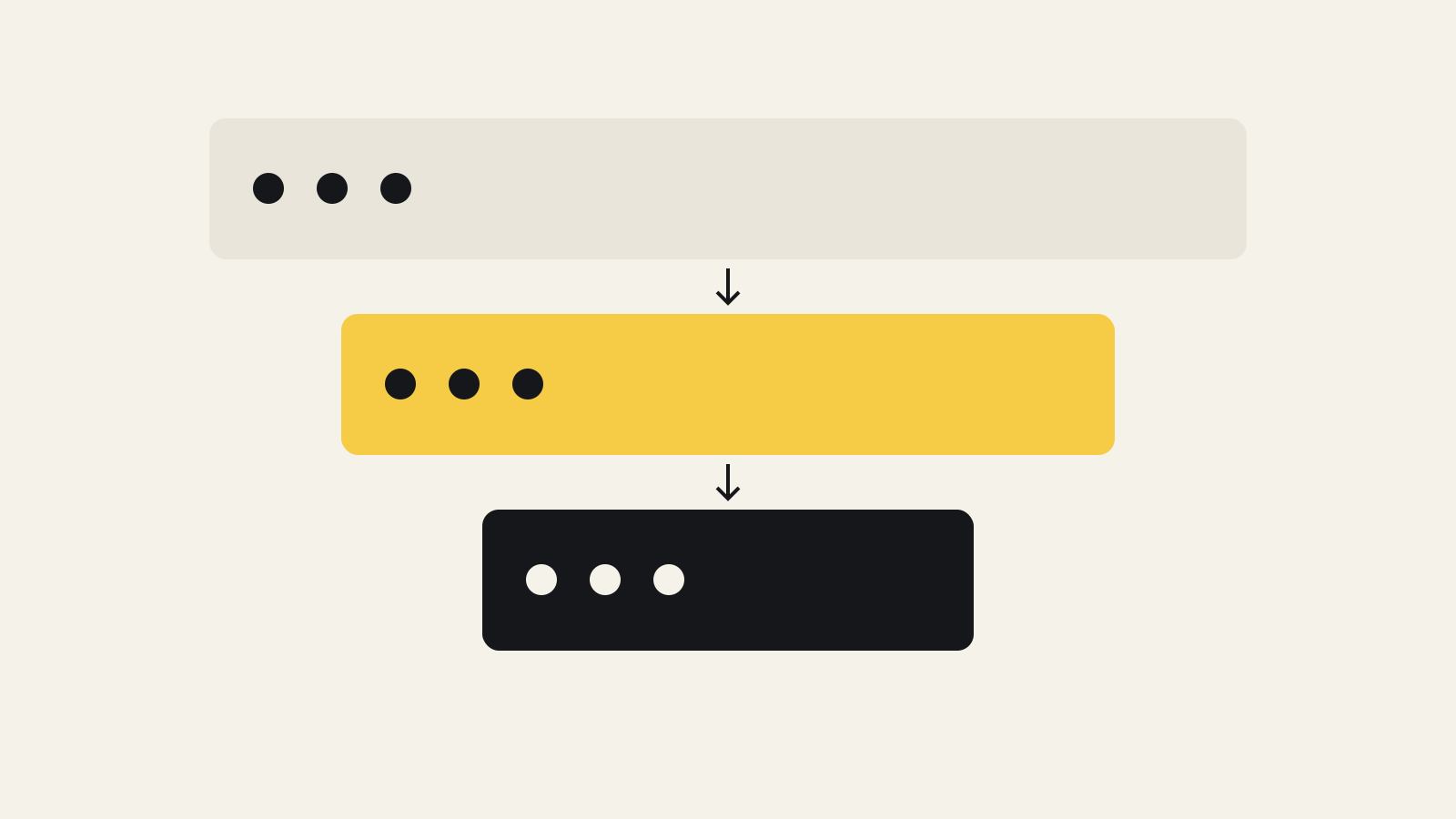
A decision loop, not an output race
- Define
Choose the customer question, primary measure and limits.
- Compare
Keep conditions comparable; record other changes.
- Decide
Continue, redesign or stop. Keep the reason.
A planning framework from DijitalPi, not a research result or a performance guarantee.
Future reporting should show more than content volume
A marketing report should explain which uncertainties were reduced as well as how much was produced. This distinction may become more visible as AI makes outputs easier to generate, while selecting the right customer problem and understanding its commercial impact remain separate skills. That future-oriented interpretation can be tested in today’s reporting process.
At month-end, ask more than how many advertisements the team prepared. Which customer objection is better understood? Which message was rejected, and why? Which result remains inconclusive? Put the learning into a shared record so the same unsuccessful idea is not tested again next month under a different name.
Converting every AI-enabled saving into more content is only one option. Some capacity can improve product information, experiments or human review. The allocation should respond to the uncertainty currently causing the business to make its most costly mistakes.
Sources
- Google: Meridian’s new measurement capabilities
- Google for Developers: GeoX experiment types
- Google Research: Meridian GeoX research record
Source-check date: September 26, 2026. The budgeting framework and campaign example are DijitalPi’s recommendations.