
The problem
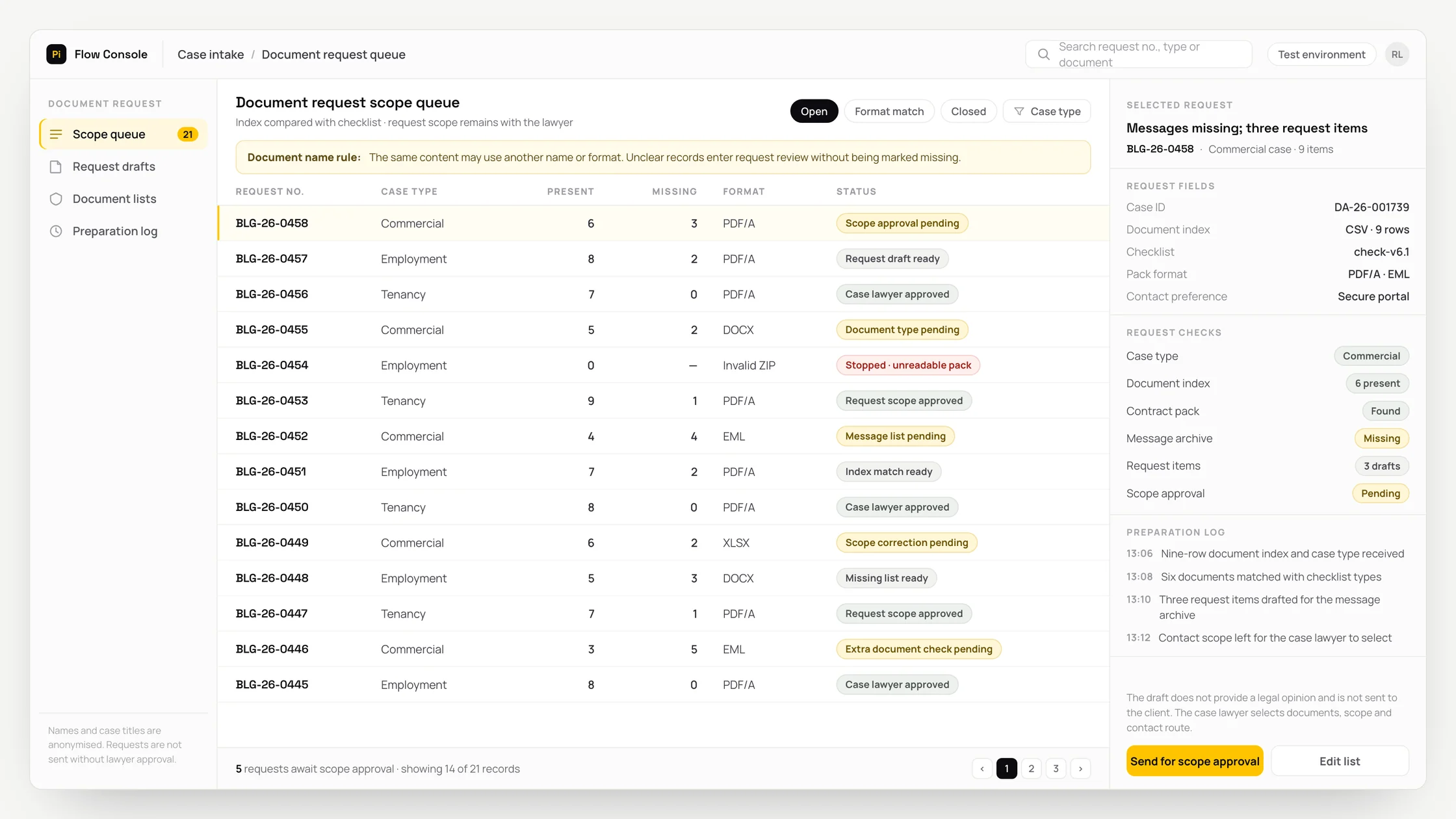
In day-to-day operations, document requests may be sent in several separate messages. When the matter type, lawyer's checklist, document index and communication preference are spread across different screens, documents or team records, the issue may not be noticed in time.
This fragmented data delays preparation of the document request draft and forces staff to search for supporting records again by hand. Before deciding, the matter lawyer must complete missing fields and verify each inconsistency individually.
A common exception is that the same content may have been uploaded under a different name or in a different format. If this context is not checked, an incomplete or incorrect automation could request unnecessary data or overlook an important document, so the output cannot be acted on directly.
What we set out to improve
- Number of document items changed by the lawyer
- Share of outputs corrected or rejected by the matter lawyer
- Time between the source record and the review output
How the system works
- 01Define the review scope and the authorised matter lawyer role
- 02Collect the inputs: matter type, lawyer's checklist, document index and communication preference
- 03Check the source identifier, date, version and data freshness
- 04Match documents against the checklist
- 05Turn missing items into a request draft
- 06Check the exception: the same content may have been uploaded under a different name or in a different format
- 07Place low-confidence or conflicting records in a separate human review queue
- 08Write the source identifier, rule, output and timestamp to the audit trail
- 09Have the matter lawyer approve, correct, defer or reject the output
Methods we used
- Matching against a lawyer-approved checklist and document types
- Source, format, version and required-field checks for the matter type, lawyer's checklist, document index and communication preference
- A missing-data alert instead of an estimate when inputs are absent or conflicting
- Separate handling of exceptions and the main rule
- Joint retention of the source identifier, rule result, document request draft and human decision
Where people stay involved
The system stops after preparing the document request draft. The matter lawyer reviews the sources and the exception, then approves, corrects or rejects the output. Direct execution remains disabled because unnecessary data could be requested or an important document could be overlooked; the system does not replace professional judgement.
Data and security
Access to the matter type, lawyer's checklist, document index and communication preference is limited to the minimum permissions needed for the task. Identifiers and sensitive fields are masked where possible, and only the necessary section is sent to the model rather than the full raw file. Access, output and the matter lawyer's decision are logged; production use does not begin until the organisation approves the retention period and data location.
Who this suits
A good fit
- Firms using a standard matter-opening process
Not a good fit
- Teams seeking to define scope without a lawyer
FAQ
Frequently asked questions
Which inputs are used?
The matter type, lawyer's checklist, document index and communication preference are used. If a required field is missing, the system does not produce a definitive result and flags the missing source for review by the matter lawyer.
At what point does a person decide?
The workflow stops when the document request draft is ready and waits for the matter lawyer's approval. The lawyer can correct, defer or reject the output with reasons.
Can the output be audited?
The design retains the source identifier, applied rule, exception, output and human decision together. This makes it possible to review how each source record led to a recommendation.
Project led by: DijitalPi
✦ PI ASSISTANT · ARTIFICIAL INTELLIGENCE
onlineAsk the DijitalPi AI Assistant your question
No need to fill in a form and wait for a reply — write your question and let Pi, trained on DijitalPi's 20 years of know-how, answer within seconds.
- Instant answers, 24/7
- Service-specific context — no generic replies
- Can connect you to a free consultation if you wish
Pi Assistant answers are for information purposes; for a proposal get in touch.
ASK AI ABOUT DIJITALPI
Let an AI explain what DijitalPi does.
Opens your chosen assistant with a ready research prompt. It reads the site live and answers.
 Cookie preferences
We use cookies to improve your experience and to analyse site traffic anonymously.Details: Cookie Policy · Privacy