
The problem
In day-to-day operations, sensor history, the asset model and operating limits are held in separate records and files, preventing the team from reviewing the same case in a single view.
As a result, the link to source evidence can be lost while preparing a scenario comparison, leading to repeated checks and uncertainty about the basis for the decision.
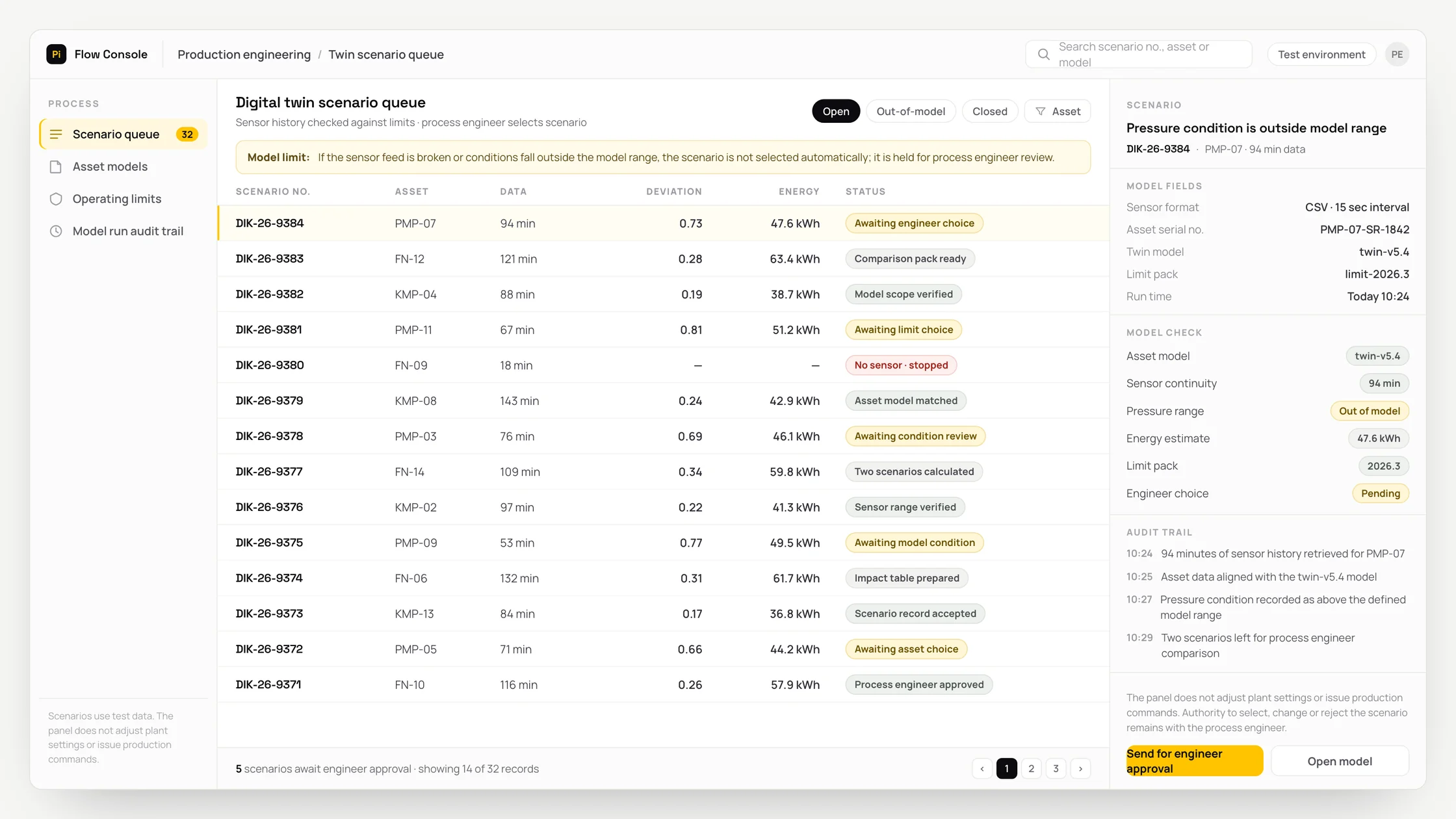
Incomplete automation may overlook a disconnected sensor or conditions outside the model, while poorly controlled automation risks a simulation being mistaken for an instruction.
What we set out to improve
- Time required to prepare a scenario comparison for review
- Correct routing of cases involving a disconnected sensor or conditions outside the model to the appropriate specialist queue
- Recording of recommendations corrected or rejected by the process engineer
How the system works
- 01Retrieve sensor history, asset model and operating limit data from an authorised source
- 02Verify the source system, record identifier and recency information
- 03Transform the fields into the target process schema
- 04Prepare a scenario comparison draft
- 05Compare the draft with business rules and source records
- 06Check for exceptions involving a disconnected sensor or conditions outside the model
- 07Obtain the process engineer's approval, correction or rejection
- 08Write the input, recommendation, changes and final decision to the audit log
Methods we used
- Source-traceable data extraction from sensor history, the asset model and operating limits
- Structured output that restricts scenario comparison fields through business rules
- An exception gate that separates cases involving a disconnected sensor or conditions outside the model
- A queue that shows the source and recommendation together for the process engineer
- Duplicate-processing controls and rollback records to mitigate the risk of a simulation being mistaken for an instruction
Where people stay involved
The process engineer makes the final decision. When a sensor is disconnected or conditions fall outside the model, the workflow stops and presents the supporting records to the specialist. The specialist can amend or reject the recommendation, or stop the process.
Data and security
Only the fields required for the task are processed from sensor history, the asset model and operating limits. Source-system permissions remain in force, and personal or commercially sensitive data is minimised before being provided to the model. Every read, recommendation, human amendment and write to the target system is logged.
Who this suits
A good fit
- Teams carrying out repetitive reviews in manufacturing operations
- Companies with defined ownership for sources and approvals
- Organisations that want exceptions to remain under human oversight
Not a good fit
- Where source data is not current
- Where the decision owner and rollback process are not defined
- Where the existing method adequately handles the low volume
FAQ
Frequently asked questions
What data is used?
Sensor history, the asset model and operating limits are used. The exact connections, fields and retention boundaries are determined during the access review.
How are exceptions handled?
The workflow stops when a sensor is disconnected or conditions fall outside the model. The record goes to the process engineer's queue with its source evidence.
How is the risk of incorrect automation controlled?
Because of the risk of a simulation being mistaken for an instruction, no final action is taken without human approval. The source, recommendation and human decision are recorded separately.
Project led by: DijitalPi
✦ PI ASSISTANT · ARTIFICIAL INTELLIGENCE
onlineAsk the DijitalPi AI Assistant your question
No need to fill in a form and wait for a reply — write your question and let Pi, trained on DijitalPi's 20 years of know-how, answer within seconds.
- Instant answers, 24/7
- Service-specific context — no generic replies
- Can connect you to a free consultation if you wish
Pi Assistant answers are for information purposes; for a proposal get in touch.
ASK AI ABOUT DIJITALPI
Let an AI explain what DijitalPi does.
Opens your chosen assistant with a ready research prompt. It reads the site live and answers.
 Cookie preferences
We use cookies to improve your experience and to analyse site traffic anonymously.Details: Cookie Policy · Privacy