
The problem
Raw AI output can appear fluent while containing fabricated statistics, false links, incorrect dates or conflated concepts.
At high production volumes, repeated patterns, duplicate sentences and generic writing that does not reflect the brand voice can spread easily.
When source verification, editorial review and SEO work depend entirely on individual attention, a consistent quality standard cannot be maintained across content.
When the system that produces a draft also reviews its own output, it can approve the same error again. Production and review therefore need to be separated.
What we set out to improve
- Number of specific claims published without source verification
- Reasons why an editor rejects a draft or requests a rewrite
- Number of broken, irrelevant or non-supporting links found before publication
- Share of content passing title, meta description, internal-link and structured-data checks
- Number of pieces published without human approval
How the system works
- 01Define the topic, target reader and search intent
- 02Record permitted sources and prohibited claim types in the brief
- 03Have AI prepare the brief-led draft section by section
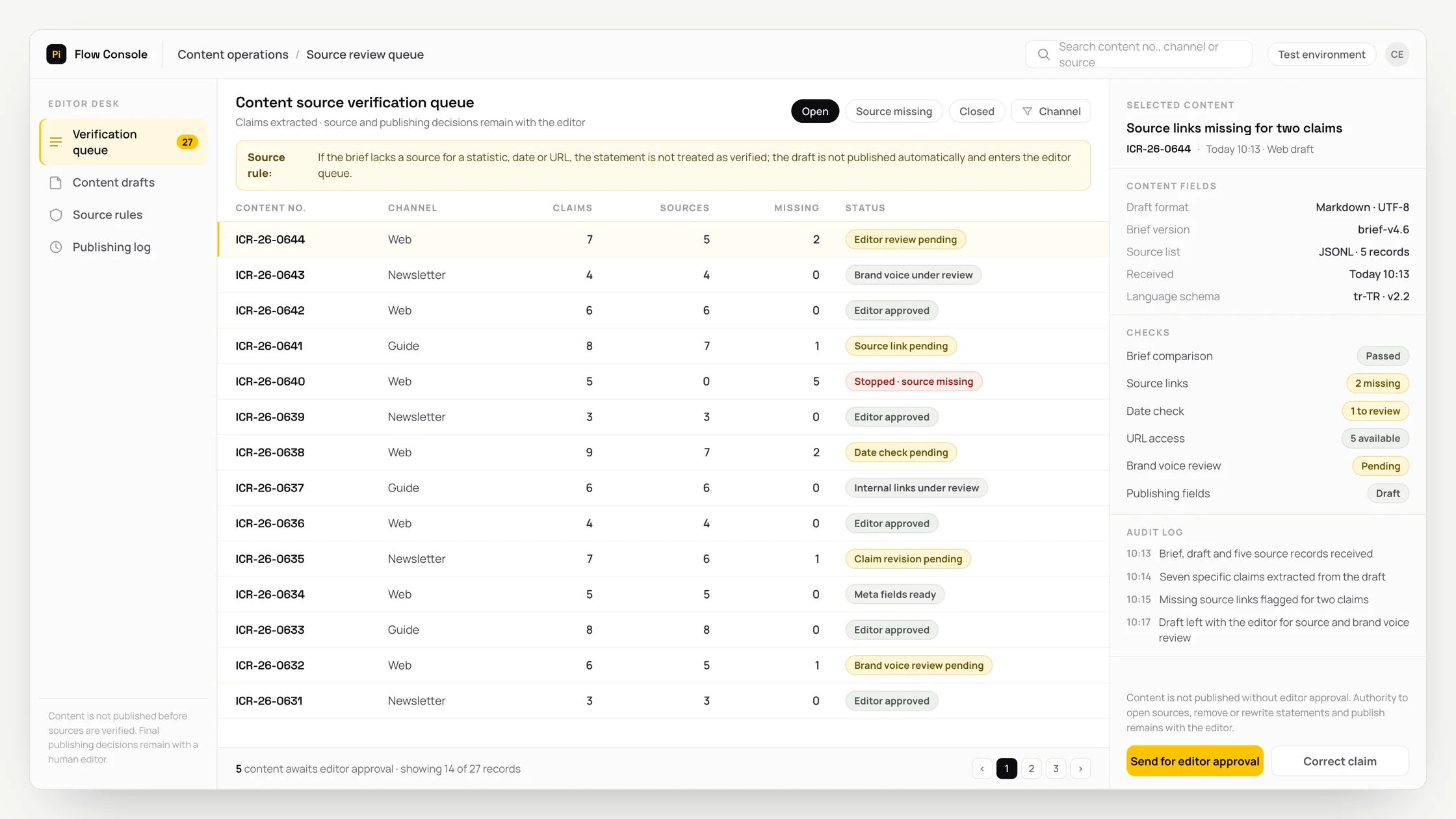
- 04Extract specific claims such as statistics, dates, names and URLs
- 05Verify claims against independent and, where possible, primary sources
- 06Remove or rewrite statements that cannot be verified
- 07Have a human editor review originality, brand voice, user value and internal consistency
- 08Review the title, meta description, internal links and schema decisions
- 09Obtain the human editor's final publishing approval
Methods we used
- Structured brief: define the topic, target reader, scope, permitted data and constraints such as not producing unsourced statistics at the outset.
- Staged drafting: prepare the text in reviewable sections rather than as one long block.
- Claim-level verification: extract statistics, dates, names and links from the text and compare each one with its source.
- Source hierarchy: use official documentation and primary sources where possible; a link that does not support the claim is not treated as evidence.
- Separation of production and review: the AI that prepares a draft cannot be its final approver.
- Human editorial review: assess accuracy, originality, brand voice, user value, suitability and internal consistency as separate quality dimensions.
- SEO and GEO review: evaluate the title, meta description, internal links, schema, definitional opening and direct-answer structure before publication.
Where people stay involved
AI supports only research and drafting; it has no publishing authority. A human editor opens the sources and checks whether they truly support the claims, assesses brand language and user value, and removes or requests rewrites of sections where necessary. Content may be published only after the editor gives explicit approval.
What we tried that did not work
Publishing a draft before the approval pipeline is operating: a repository record shows that one piece was released with repetition, placeholder remnants and a source that did not support its claim; human review rejected and withdrew it.
Treating an accessible link as source verification: the fact that a page opens does not mean it supports the statement in the text. Its content must be compared directly with the claim.
Asking the model both to produce text and approve its own text: without a separation between producer and reviewer, the same error can be missed during the checking stage.
Keeping an unsourced figure by softening its wording: an unverifiable number or causal claim should be removed, not restyled.
Increasing publishing volume independently of quality-control capacity: when human review cannot keep pace, the risk of repetition, generic writing and unverified claims rises.
Data and security
Source access, draft editing and publishing permissions are separated by role. Drafts, source checks, editor revisions and the final publishing decision are logged so that each published claim can be traced to its evidence and reviewer.
Who this suits
A good fit
- Brands producing regular content such as blog posts, guides, service pages or newsletters
- Teams seeking to increase drafting capacity with AI without enabling direct publication
- Companies producing content that includes statistics, regulation, product features or current information
- Teams seeking consistent brand language and SEO structure across their content
Not a good fit
- Teams seeking to publish raw AI output without review
- Projects that require precise figures and strong outcome claims without providing sources
- Operations unable to allocate a human editor to take responsibility for publishing approval
- Brands expecting assured search rankings or visibility
FAQ
Frequently asked questions
Is AI content published directly?
No. AI prepares a draft; a human editor completes the source, editorial-quality and SEO checks. AI is not given the final publishing decision.
Can hallucinations be eliminated completely?
Complete elimination cannot be claimed. A structured brief, verified sources, claim-level checks and a human editorial layer reduce the risk. Information that cannot be verified is not published.
How are sources checked?
Specific statements such as statistics, dates, names and URLs are reviewed individually. It is not enough for a link to open; the reviewer checks whether the source actually supports the relevant claim.
What does the SEO review cover?
It covers the title, meta description, search intent, internal links, schema decisions, definitional opening and a structure that answers the user's question directly. These checks do not assure search rankings.
Is using AI to produce content inherently a problem for search engines?
The production tool alone does not determine quality. The principal risk is publishing content at scale without review or user value. A human editor alone is not enough either; the content must be genuinely useful and verified.
Is a human editor required for every piece?
Yes, under this method. Production and publication are separate, and every draft requires the human editor's explicit approval before publication.
Project led by: DijitalPi
✦ PI ASSISTANT · ARTIFICIAL INTELLIGENCE
onlineAsk the DijitalPi AI Assistant your question
No need to fill in a form and wait for a reply — write your question and let Pi, trained on DijitalPi's 20 years of know-how, answer within seconds.
- Instant answers, 24/7
- Service-specific context — no generic replies
- Can connect you to a free consultation if you wish
Pi Assistant answers are for information purposes; for a proposal get in touch.
ASK AI ABOUT DIJITALPI
Let an AI explain what DijitalPi does.
Opens your chosen assistant with a ready research prompt. It reads the site live and answers.
 Cookie preferences
We use cookies to improve your experience and to analyse site traffic anonymously.Details: Cookie Policy · Privacy