
The problem
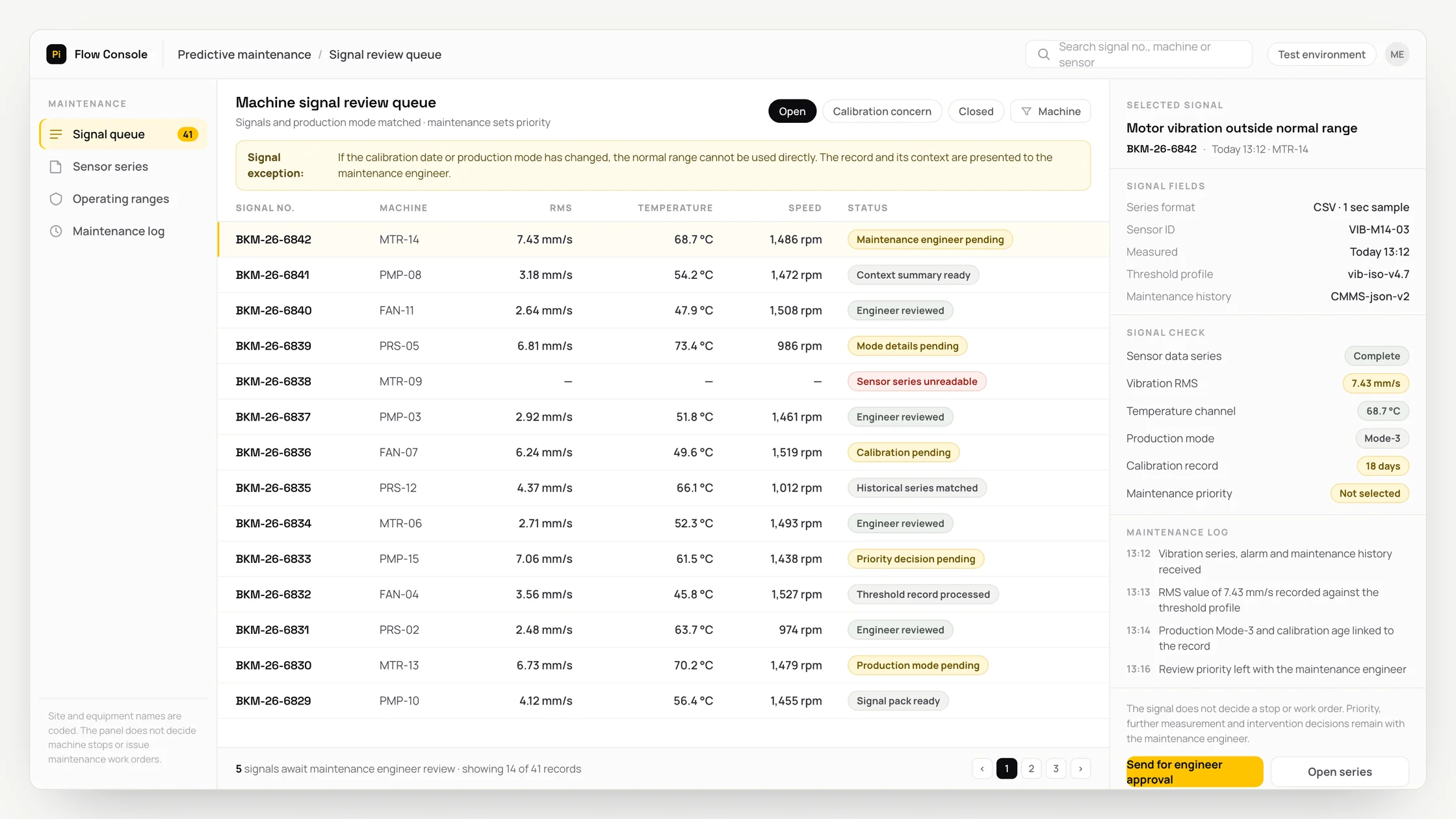
When sensor series, alarms and maintenance history are held in different sources, fields have to be matched by hand before a draft maintenance review priority can be prepared.
The maintenance engineer must compare every suggestion in the maintenance review priority with its source record; missing or conflicting evidence must not take the place of a final decision.
If signal distortion caused by calibration or a change in production mode is not separated for review, an unnecessary stoppage may occur or a genuine fault may be deferred; the record must not progress without a human decision.
What we set out to improve
- Time for the draft maintenance review priority to reach the maintenance engineer with its supporting evidence
- Outcomes of records separated for human review because calibration or a change in production mode distorted the signal
- Number of suggestions corrected after identifying the risk of an unnecessary stoppage or a deferred genuine fault
How the system works
- 01Receive the sensor series, alarm and maintenance history from permitted sources with the record identity
- 02Link the source, date and version details to a common work record
- 03Validate fields and units
- 04Prepare the maintenance review priority with its supporting evidence
- 05Check the exception: calibration or a change in production mode may distort the signal
- 06Have the maintenance engineer accept, correct or reject the suggestion
- 07Write the approved decision and its source to the activity log
Methods we used
- A common, source-identified data schema for the sensor series, alarm and maintenance history
- A decision structure that separates deterministic rules from AI suggestions
- A review screen showing the maintenance review priority beside the raw evidence
- A mandatory human review queue when calibration or a change in production mode distorts the signal
- An event identity that prevents duplicate processing
Where people stay involved
The maintenance engineer compares the maintenance review priority with the supporting record. Progress stops when calibration or a change in production mode may have distorted the signal. The responsible person can change or reject the suggestion, or request further information.
Data and security
Sensor series, alarms and maintenance history should be processed using only the fields required for this decision. Access to the source should be authorised separately from the maintenance engineer role; personal data, commercial information and technical secrets should not be passed into the model context unless needed. Reading, suggestions and human decisions should be logged separately.
Who this suits
A good fit
- Teams that regularly prepare maintenance review priorities
- Organisations that combine sensor series, alarms and maintenance history by hand
- Companies that want exception decisions to remain with people
Not a good fit
- Teams whose source data is not current and consistent
- Teams where responsibility for maintenance engineering has not been defined
- Teams that would apply AI suggestions without review
FAQ
Frequently asked questions
What data does the system use?
Sensor series, alarms and maintenance history can be received through an API or controlled file transfer. Fields whose source and version cannot be established are not treated as definitive information.
When does the process stop?
The record goes to the maintenance engineer when this exception occurs: calibration or a change in production mode distorts the signal. No action is taken in the target system if supporting evidence is missing.
Does AI apply the decision on its own?
No. The maintenance review priority remains a draft until the maintenance engineer approves it. Acceptance, correction and rejection are written to the activity log as human decisions.
Project led by: DijitalPi
✦ PI ASSISTANT · ARTIFICIAL INTELLIGENCE
onlineAsk the DijitalPi AI Assistant your question
No need to fill in a form and wait for a reply — write your question and let Pi, trained on DijitalPi's 20 years of know-how, answer within seconds.
- Instant answers, 24/7
- Service-specific context — no generic replies
- Can connect you to a free consultation if you wish
Pi Assistant answers are for information purposes; for a proposal get in touch.
ASK AI ABOUT DIJITALPI
Let an AI explain what DijitalPi does.
Opens your chosen assistant with a ready research prompt. It reads the site live and answers.
 Cookie preferences
We use cookies to improve your experience and to analyse site traffic anonymously.Details: Cookie Policy · Privacy