
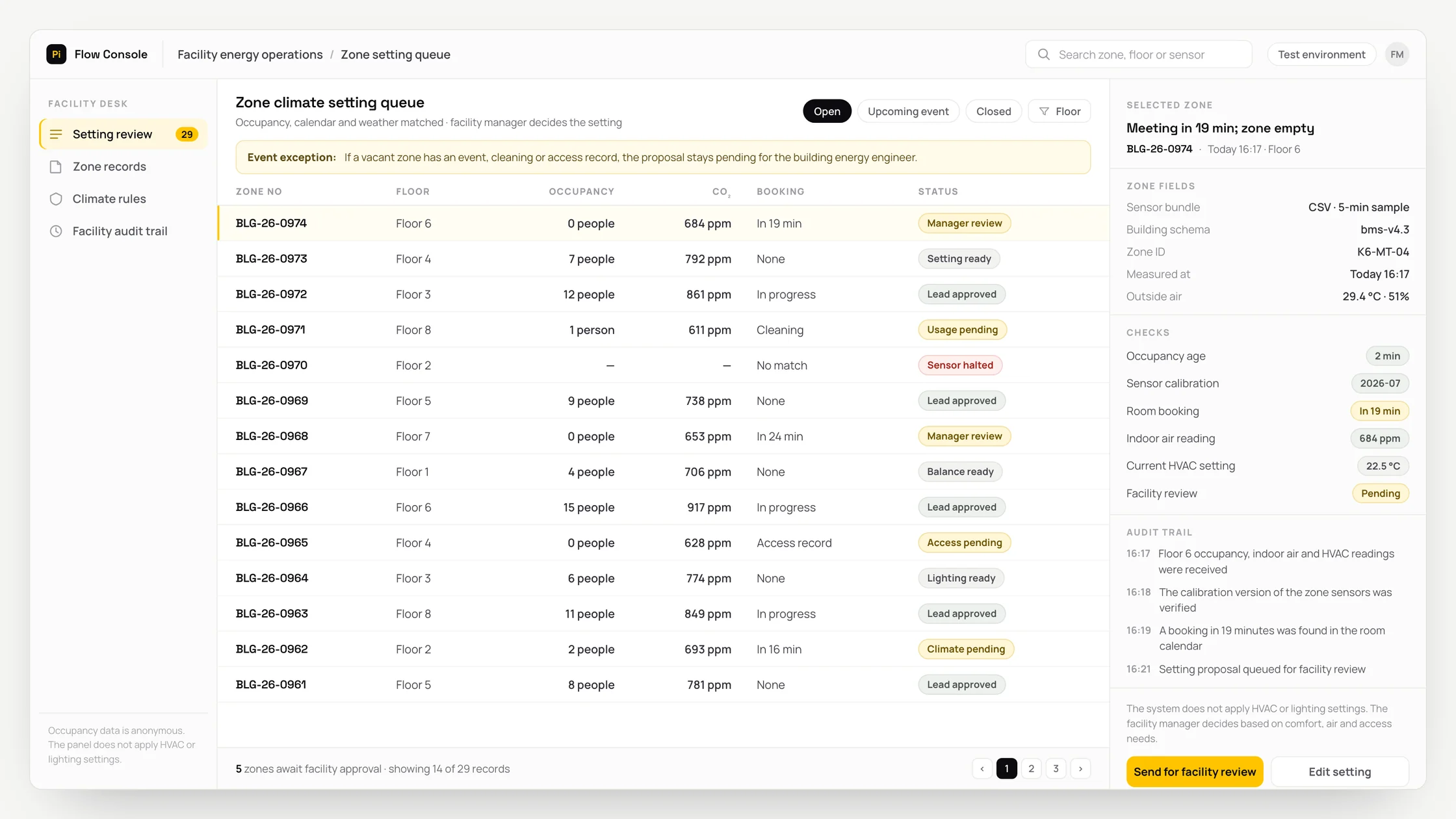
The problem
In day-to-day operations, differences between calendars and actual occupancy can lead to unnecessary energy use. When anonymous occupancy counts, room bookings, working hours, indoor conditions, outdoor conditions, HVAC status and lighting status are scattered across sensors, documents, field records or team files, issues may not become visible in time.
This fragmented data delays preparation of zone-level HVAC and lighting suggestions and forces teams to search manually for supporting evidence again. The facilities manager or building energy engineer must complete missing records and verify each conflict before making a decision.
A common exception is that events, cleaning, accessibility requirements or indoor-air needs may make an apparently empty area active. Incomplete or incorrect automation that fails to check this context could compromise employee comfort, indoor air quality or safe access, so no physical or operational action can be carried out directly.
What we set out to improve
- Proportion of zone-setting suggestions accepted by the facilities manager
- Proportion of outputs corrected or rejected by the facilities manager or building energy engineer
- Time between the source event and the review output
How the system works
- 01Define the review scope and the role of the authorised facilities manager or building energy engineer
- 02Retrieve the inputs: anonymous occupancy counts, room bookings, working hours, indoor conditions, outdoor conditions, HVAC status and lighting status
- 03Check source identity, date, calibration or version, and data recency
- 04Check occupancy data recency and zone assignment
- 05Prepare options using bookings, weather conditions and current settings
- 06Check for exceptions: events, cleaning, accessibility requirements or indoor-air needs may make an apparently empty area active
- 07Place low-confidence or conflicting records in a separate specialist queue
- 08Write the source identity, rule, output and timestamp to the audit trail
- 09Have the facilities manager or building energy engineer approve, correct, defer or reject the output
Methods we used
- Zone-level constraints and comfort limits without person recognition
- Source, format, timing and required-field checks for anonymous occupancy counts, room bookings, working hours, indoor conditions, outdoor conditions, HVAC status and lighting status
- A missing-data warning instead of an estimate when inputs are incomplete or conflicting
- A separate exception check outside the main rule
- Combined retention of the source, rule result, zone-level HVAC and lighting suggestions and human decision
Where people stay involved
The system stops after preparing zone-level HVAC and lighting suggestions. The facilities manager or building energy engineer reviews the sources and the exception, then approves, corrects or rejects the output. Direct execution is disabled because employee comfort, indoor air quality or safe access could be compromised; the final specialist and operational decisions remain with people.
Data and security
Access to anonymous occupancy counts, room bookings, working hours, indoor conditions, outdoor conditions, HVAC status and lighting status is restricted to the minimum permissions required for the task. Commercial, location and employee information is masked where possible, and only the necessary portion of the dataset is sent to the model. Access, outputs and the facilities manager or building energy engineer's decision are logged; production use does not begin until the organisation has approved the retention period and data location.
Who this suits
A good fit
- Offices with anonymous occupancy data and zone controls
Not a good fit
- Organisations seeking unapproved changes to critical building settings
FAQ
Frequently asked questions
What inputs are used?
Anonymous occupancy counts, room bookings, working hours, indoor conditions, outdoor conditions, HVAC status and lighting status are used. If a required field is missing, the system does not produce a definitive result and shows the missing source to the facilities manager or building energy engineer for review.
At what point does a person make the decision?
The workflow stops when the zone-level HVAC and lighting suggestions are ready and waits for approval from the facilities manager or building energy engineer. The specialist can correct, defer or reject the output with a recorded reason.
Can the output be audited?
The system is designed to retain the source identity, rule, exception, output and human decision together. This allows teams to review later how each piece of data informed a suggestion.
Project led by: DijitalPi
✦ PI ASSISTANT · ARTIFICIAL INTELLIGENCE
onlineAsk the DijitalPi AI Assistant your question
No need to fill in a form and wait for a reply — write your question and let Pi, trained on DijitalPi's 20 years of know-how, answer within seconds.
- Instant answers, 24/7
- Service-specific context — no generic replies
- Can connect you to a free consultation if you wish
Pi Assistant answers are for information purposes; for a proposal get in touch.
ASK AI ABOUT DIJITALPI
Let an AI explain what DijitalPi does.
Opens your chosen assistant with a ready research prompt. It reads the site live and answers.
 Cookie preferences
We use cookies to improve your experience and to analyse site traffic anonymously.Details: Cookie Policy · Privacy