

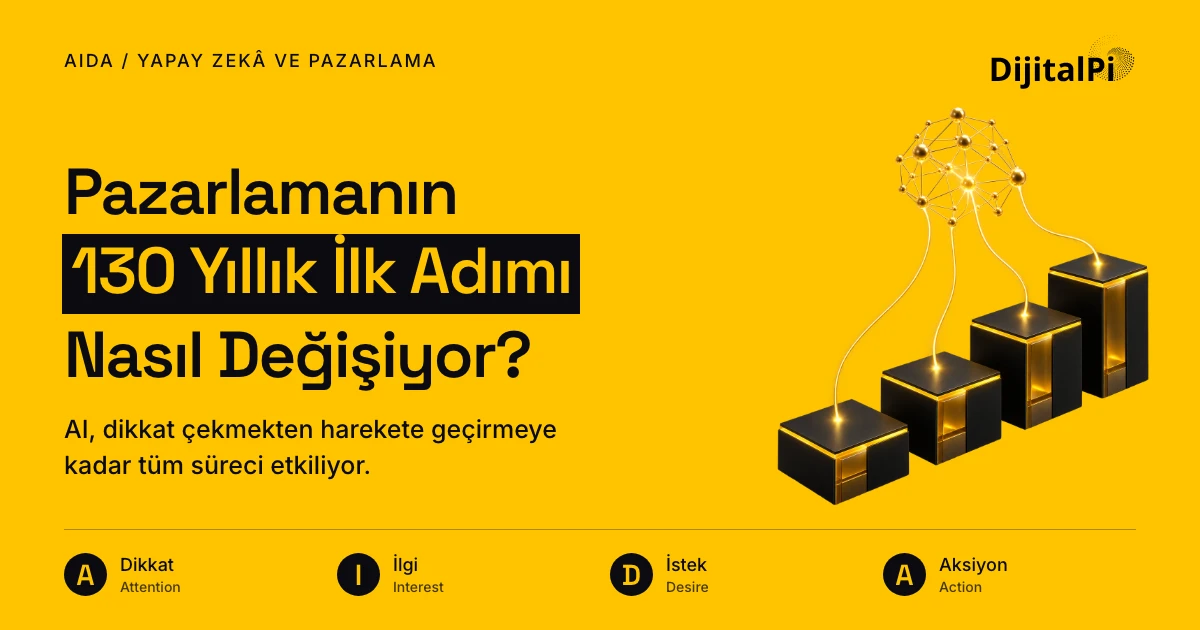
The AIDA approach, whose origins go back roughly 130 years, sought to answer one of marketing's most familiar questions: how do we attract someone's attention and persuade them to act? From newspaper advertisements to television, search engines and social media, the same question has appeared across different channels.
With artificial intelligence, we now need to ask it again: A stands for Attention. But whose attention are we trying to attract now: a person's or an AI system's?
The change also extends beyond the first step. Customers can use AI to gather information, compare options, assess a brand's trustworthiness and move towards a purchase. In this article, we use AIDA as a framework for thinking about how to adapt the entire marketing process to this change.
Summary: In AI-assisted customer journeys, being discovered matters, but so do accurate representation, comparability, trust and an easy path to completing a transaction. AI visibility is one part of that process. At each of AIDA's four stages, businesses need to reassess customers' needs and the information sources influencing them.
What Is AIDA? Four Letters, Four Marketing Tasks
AIDA describes the journey from encountering a product or service to taking action through four stages:
- A = Attention. Helping someone notice the brand or the solution it offers.
- I = Interest. Helping them connect it to their own needs and want to learn more.
- D = Desire. Helping them believe the product or service suits them and move closer to choosing it.
- A = Action. Making the next step easier, whether that means purchasing, requesting a quote, booking an appointment or making contact.
This is not a complete, one-way path followed by every customer. People may return to earlier stages, experience several together or enter through different channels. AIDA's value is in reminding marketers that each stage presents a distinct task to solve.
About “130 years”: Popular accounts trace AIDA to E. St. Elmo Lewis in 1898. However, who first formulated the model and when remain disputed. Akinori Iwamoto's historical investigation into AIDA's origins questions the evidence for this common attribution. We therefore refer to an approximate historical period, rather than claiming that one person introduced the four-stage model on a single date.
A = Attention: Whose Attention Are We Trying to Attract?
For a long time, the main task was to win human attention. An effective headline, a strong advertisement opening or a search result that answered a need were ways to achieve this. Search and social media algorithms already influenced visibility. Generative AI introduces another form of this mediation by preparing answers and comparing options.
Imagine a business owner asking: “Recommend three digital marketing agencies for my online shop and explain their differences.” Instead of researching each option individually, the user may begin with a system-generated shortlist. If your brand does not appear in that answer, you may miss the opportunity to attract attention at that particular touchpoint.
“Attracting AI's attention” is a metaphor here. AI does not take an interest like a person or decide like a customer with independent intentions. The issue is whether your brand can be found, correctly understood and included in an answer through the sources and search tools used by the system in response to the user's question.
While winning human attention remains necessary, accurate representation by AI is becoming important too. This does not mean that every customer journey starts with AI, or that a brand absent from one answer is invisible throughout its market.
What should a business do? Explain clearly what it offers, whom it serves and which need it addresses. Check that information is consistent across its website, business profiles and third-party sources. We explore the visibility aspect in becoming visible in ChatGPT searches.
I = Interest: Where and How Does the Customer Obtain Information?
Once customers notice a brand, their next question is: “Is this solution relevant to my needs?” Previously, businesses mainly developed this interest through web pages, catalogues, videos and sales conversations. Customers can now ask AI to summarise these materials and answer questions about their particular circumstances.
The same business owner might ask: “Which of these agencies works with small ecommerce teams? What do their SEO, advertising and reporting services include?” If your service page is vague, the answers may also be incomplete. A slogan can attract attention; information explaining the scope helps customers progress with their research.
Content strategy should therefore address the questions customers actually ask: Who is the service suitable for? How does the process work? What is included or excluded? What preparation is expected from the customer?
What should a business do? Present service scope, examples and frequently asked questions under clear headings. Keep content current and do not assume that AI will correctly fill in missing information. These explanations can support both human research and accurate summaries by systems using the sources.
D = Desire: How Do Preference and Trust Develop?
Interest and preference are different. Customers may understand a solution yet decide that it does not suit their budget, expectations or working style. At the Desire stage, the value you offer needs to connect with the outcome the customer wants.
When the business owner asks, “Compare these three agencies by sector experience, service scope, reporting method and total cost,” AI can assist with part of the selection process. Concrete, comparable information is more useful here than general praise.
A case study should explain the starting position, the work performed, the period and the measurement method, rather than simply displaying a high success rate. Readers should understand what a reference demonstrates; one customer's result must not be presented as a guarantee for everyone. Reliable information helps customers assess the fit between their expectations and your service.
What should a business do? Provide verifiable case studies, a clear approach to pricing, service limitations and real customer experiences. Do not automatically equate a recommendation in an AI answer with increased trust or sales. Emotional, personal and organisational influences on decisions still matter.
A = Action: Do Interest and Preference Become a Real Transaction?
A customer close to choosing a brand may stop if the transaction introduces uncertainty. A broken form, unexplained delivery conditions or an unanswered quote request can waste the interest built during earlier stages.
AI can help at this stage too. Customers can ask it to prepare questions before a meeting; a business assistant can answer service questions and direct people to appointment or quotation forms. Systems with suitable tools and integrations may also support certain transaction steps. It should not be assumed that every AI application can complete purchases or reservations.
In the agency example, the final step is a customer with a defined need requesting a meeting with an appropriate scope. The form must work, the request must reach the relevant team, someone must respond and commitments must be honoured.
What should a business do? Simplify contact, appointment, quotation and purchasing journeys, and establish follow-up for enquiries. Clearly define what automation is allowed to do and provide a handover to a person when necessary. Evaluate success through completed enquiries and sales outcomes, as well as button clicks.
AI Visibility: An Opportunity at the Start, Not the Entire Process
AI visibility can be understood as a brand appearing in relevant AI answers and being represented accurately. However, a single recommendation does not automatically generate interest, trust or a purchase.
The sequence “AI Visibility → Attention → Interest → Desire → Action” can be a useful metaphor for discovery beginning with AI. Presenting it as a new, definitive marketing model everyone must follow would be incomplete. AI may also enter during comparisons, an existing customer's enquiry or preparations for a transaction.
This article proposes examining changing customer behaviour across all four AIDA stages. Clear information, reliable evidence and an easy transaction experience remain valuable even when customers do not arrive through AI.
How Can We Adapt Each AIDA Stage to AI?
| Stage | Question to ask | Priority work |
|---|---|---|
| Attention | Where do customers discover us? How are we represented in AI answers? | Clear brand information, accessible content and visibility monitoring for relevant queries. |
| Interest | Can customers understand whether the solution suits them? | Service scope, use cases and current answers to real questions. |
| Desire | What reasons and evidence do they have for choosing us? | Results with context, comparable information and realistic expectations. |
| Action | Can they easily complete the contact or purchasing step? | Working transaction journeys, enquiry tracking, a response process and human support when needed. |
Start by choosing one customer group and a purchasing need. List the questions that customer asks from discovery to decision. Then assess your website, content, references and transaction steps against those questions. Distinguish missing information from technical problems: new automation alone cannot solve an unclear service scope.
When evaluating AI answers, record the question, date, system and, where possible, version. Revisit the same question at different times: is the brand name correct, is the service described accurately, and which sources are linked? Do not infer overall visibility or success from a single response.
Consider these observations alongside available referral traffic, qualified enquiries and sales data. Asking customers how they found you can also help. AI's full influence may not appear as a separate channel in analytics tools, so do not turn an unmeasured contribution into definitive sales attribution.
What Happens to SEO and Content Work?
Adapting to AI does not require abandoning existing digital foundations. Google Search Central's guide to AI features explains that basic SEO practices still apply to AI Overviews and AI Mode; no special AI file or separate schema is required. Technical eligibility does not guarantee inclusion in results. This guidance concerns the specified Google products; the same rules cannot simply be applied to every AI system.
Clear, human-readable content, accessible pages and consistent business information provide a good starting point. When considering AEO, GEO and their differences from SEO, they should remain connected to the rest of marketing. We discuss the search relationship in what is AI SEO? and Google-specific practices in our AI Overviews content optimisation guide.
Conclusion: Adapting from the First Question to the Final Transaction
“Whose attention are we trying to attract?” is a strong starting point for discussing marketing's transformation. The next questions are: “How will customers understand us, why will they trust us, and what will help them take action?”
The roughly 130-year-old AIDA approach makes these tasks visible. AI influences the channels, information sources and forms of interaction through which customers encounter them. Brands therefore need to adapt their entire marketing process, from attracting attention to making a sale, to the customer behaviours changing with AI.
References
- Akinori Iwamoto: The Origin of AIDA: Who Invented and Formulated the AIDA model? A historical investigation of the model's origins.
- Google Search Central: AI features and your website Content and technical eligibility guidance for Google's AI search features.
Editorial note: The stage-by-stage framework relating AIDA to AI is DijitalPi's interpretation presented for discussion in this article. It is not presented as a single behaviour model proven for all customers.
Last updated: 15 September 2026 · Author: Selim Çitil · Editor: DijitalPi Editorial Team


 Cookie preferences